Experience visionary states with ganzflicker
a luminous launchpad into liminal dreaming

To sit, with eyes closed, in front of a stroboscopic lamp is a very curious and fascinating experience.
Aldous Huxley. The Doors of Perception: And Heaven and Hell
Not believing at that time, as I do today, that the potential for a mystical experience is the natural birthright of all human beings, I attributed everything that happened to the combined effect of LSD and the stroboscopic light.
Stanislav Grof, The Way of the Psychonaut, Volume I: Encyclopedia for Inner Journeys


Strobonaut is a stroboscopic ganzfeld (ganzflicker) which delivers alternating bilateral stimulation — each eye stimulated alternately by a flash of light. Alternating bilateral stimulation is a standard treatment component of the evidence-based trauma therapy EMDR and alternating strobe is believed to be more therapeutic than stroboscopic stimulation delivered synchronously to both eyes.
Strobonaut is used in a smartphone Virtual Reality headset for meditation and music-listening reverie to give psychedelic effects promoting mental health and creativity. It gives access to altered states of consciousness and vivid dream-like visual imagery released from the deep brain / unconscious.
The uniform unstructured visual field of a ganzfeld increases the alpha rhythms of the brain, oscillations in the 8-12 Hz frequency range which are associated with visual imagery and creativity. Strobonaut combines ganzfeld with bilateral alternating flicker sweeping through the 8-12 Hz frequency range, boosting alpha further by neural entrainment. The combination of the two as ganzflicker is therefore exceptionally effective for promoting the psychedelic release of visual imagery 1, 2.
For further information on the neuroscience see the Current Research section at the foot of this page.
- MacKisak, M., & Reeder, R.R., 2022. Manipulating light can induce psychedelic experiences – and scientists aren’t quite sure why. The Conversation, https://doi.org/10.64628/AB.kmyxfk7qn
- Königsmark, V.T., Bergmann, J. & Reeder, R.R., 2021. The Ganzflicker experience: High probability of seeing vivid and complex pseudo-hallucinations with imagery but not aphantasia. Cortex, 141, pp.522-534. https://doi.org/10.1016/j.cortex.2021.05.007
Strobonaut web
Please read the Safety Information before trying Strobonaut:

Strobonaut can be accessed directly in your phone’s browser with no installation required. Have your phone’s auto-rotate switched on so the screen is in landscape orientation when mounted in a headset, brightness 100%, screen timeout switched off or extended to maximum.

Strobonaut app
Strobonaut is also available as an app for android phones. The Strobonaut app can be switched from ganzflicker into Eye Movement mode for implementing EMDR therapy and self-therapy. The app proved effective during Covid lockdown for delivering remote EMDR and home use of self-help EMDR.

Flicker Drive
The Flicker Drive page of this website gives suggestions on how to fly Strobonaut in ganzflicker meditation and visioning. It borrows terminology from Russell Hoban’s visionary sci-fi novel Fremder using the metaphor of space travel to describe the flicker journey into an altered state of consciousness. It gives techniques such as the flicker jump for raising the level of consciousness:

Flicker Drive includes a useful launch sequence for session induction, based on the phenomenology of the hallucinatory progression with ganzflicker — from phosphene to tunnel to ganzfeld mist to scenes and filmstrips:
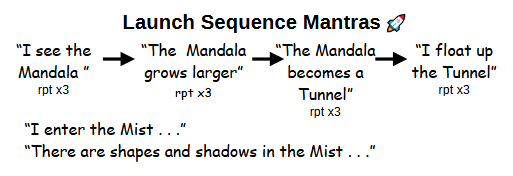

by A.F.
Flickerspace
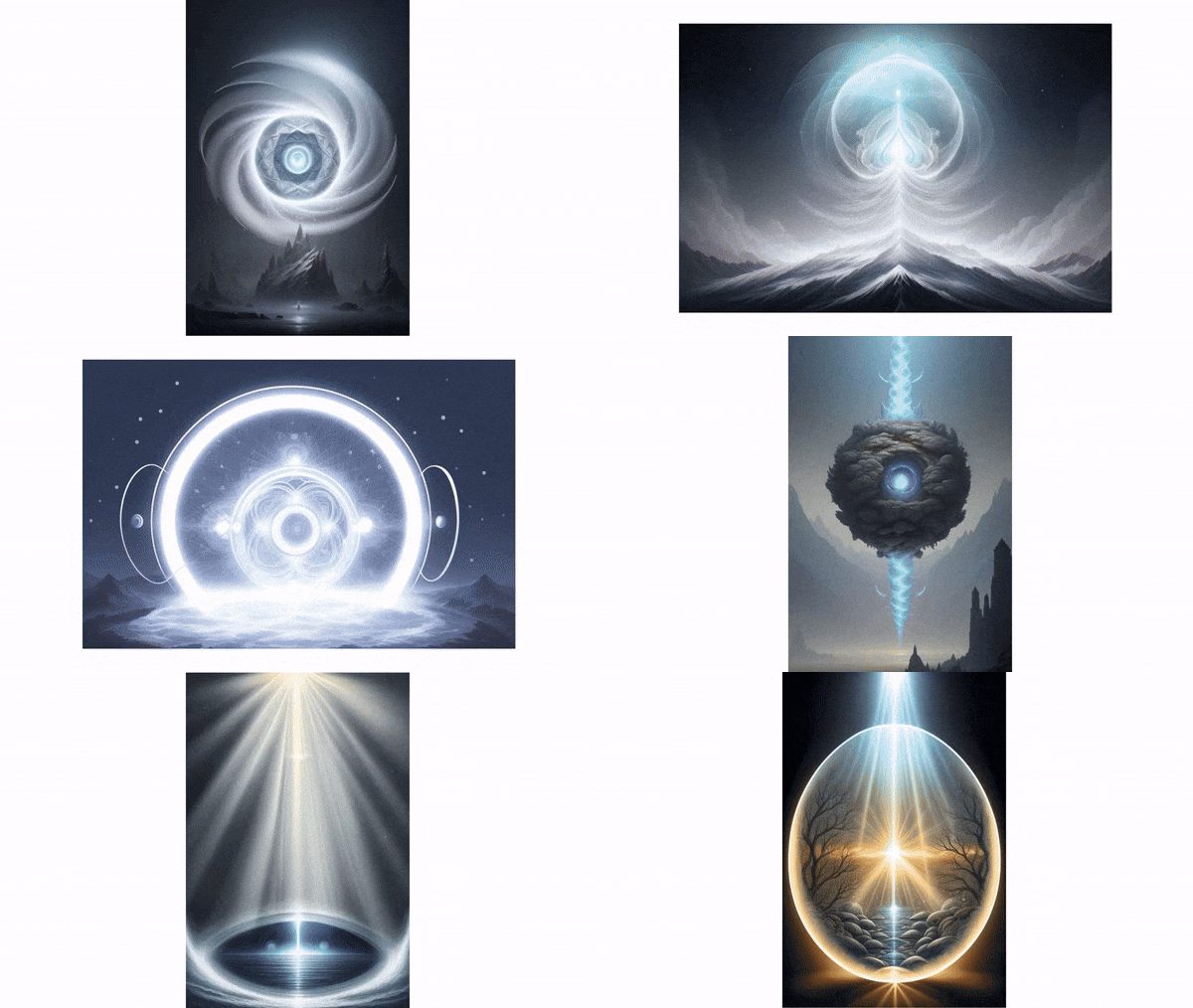
The Flickerspace page describes the hallucinatory progression from elementary to complex levels of visioning using the metaphor of space travel:
Region 0: The Launchpad — Blank Screen
Region I: Ignition — Central Focus / Mandala
Region II: Atmospheric Exit — Patterns / Tunnel
Region III: Orbit — Luminous Mist / Shadowy Shapes
Regions IV and V: Interplanetary Space — Scenes, Settings, and Filmstrips
Region VI: Interstellar Space — the Numinosum
Region VII: The Destination Star — Mystic Bright Light

Smartphone VR Headsets for Ganzflicker

Basic smartphone VR headsets are inexpensive and widely available:
- These are simple holders with lenses that turn your phone into a VR display — not expensive standalone VR gaming systems
- They are lightweight, easy to use, and can be found online and in stores worldwide
- Any smartphone VR headset that fits your phone can be used for ganzflicker meditation with Strobonaut
For Strobonaut app’s EMDR eye movement features:
- The Destek V5 headset (recommended) includes a touch button that allows you to switch between ganzflicker mode and eye movement mode during your session
- The Destek V5 is currently available on ebay for £10-£20
Current Research
In order to understand the working brain as a network, it is essential to identify the mechanisms by which information is gated between regions. We here propose that information is gated by inhibiting task-irrelevant regions, thus routing information to task-relevant regions. The functional inhibition is reflected in oscillatory activity in the alpha band (8–13 Hz).Jensen & Mazaheri, 2010, Shaping functional architecture by oscillatory alpha activity: gating by inhibition
Adrian and Matthews (1934) reported that when subjects open their eyes in a uniform visual field (illuminated or completely dark) a short time after the usual α-blocking effect synchronisation reappears. Lehtonen and Lehtinen (1972) examined the effects of a uniform visual field on α rhythm. The authors found that eyes open in a uniform visual field (sheet of paper placed in front of eyes) or ganzfeld (translucent hemisphere) led, after an initial delay, to reappearance of α activity that is comparable to the eyes closed level.
Putz Braeunig & Wackermann, 2006, EEG correlates of multimodal ganzfeld induced hallucinatory imagery
The Fingelkurts meditation studies1 show that the hallmark neurophysiological trait of deep long-term meditative development is increased frontal alpha synchrony — the frontal Observer coming into fuller prominence, with relative fading of posterior Narrator and Embodier. Independently, Lindahl et al. 20142 found that meditation-induced luminous experiences — ranging from discrete phosphenic points to diffuse brightening of the entire visual field — arose consistently in the context of heightened concentration and were neurophysiologically preceded by increases in global alpha power, implicating alpha-mediated functional inhibition and sensory suppression as the gateway to such light phenomena.
In a self-experimentation study I found that closing the eyes for a few minutes during ganzflicker meditation, then reopening them, reliably produces a striking increase in the apparent brightness of the visual experience about 20–40 seconds later3. This timing aligns with the known rebound dynamics of the brain’s alpha rhythm4. Three influences act together here to raise alpha — the ganzfeld, the flicker, and the rebound of alpha that follows a period of eye closure. Yet alpha is an inhibitory rhythm: more of it should make the visual world fade, not blaze. Alpha’s gating function is known to suppress the primary visual pathway5, so rebound should lead to a fading rather than brightening of the visual experience.
The research literature suggests an elegant resolution of this paradox. While alpha rebound quietens the brain’s normal cortical visual system, the flickering light continues to activate a much older visual pathway centred on the superior colliculus of the deep brain. Research has shown that this evolutionarily ancient pathway is highly responsive to flickering light and can continue processing visual signals independently of the primary visual cortex6.
It is therefore hypothesised that the extraordinary luminous “white light” experience arises because the brain’s usual visual processing is temporarily turned down whilst simultaneously this older pathway is being strongly driven. Rather than alpha-mediated visual fading, “fade-out” or “mist” being a well recognised phenomenon of ganzfeld alone, ganzfeld combined with flicker triggers the bright light experience that has been described for centuries in meditation, mystical experience, psychedelic states and near-death experiences. Ganzfeld induces the mist; and flicker induces the brightening of that mist.
The bright light experience is one form of mystical peak experience, traditionally much sought after in religious contexts but now a frequently reported phenomenon of psychedelic drug and near-death experiences. Mystical experience is a well-organised, culturally configured and usually well-practised alteration of waking consciousness whose hallucinatory and often apparently noetic contents have as their core phenomenology a luminosity suffused with numinous significance. Such experience is not derived from the ordinary perceptual construction of the external world, but is felt as deriving from direct encounter with, or immersion in, a reality of ultimate significance. Mystical experience typically supervenes only after sustained concentrative absorption — most often the fruit of disciplined practice — has stilled both ordinary perception and the stream of discursive thought, but may occur spontaneously, or through psychedelic agents, or in the crisis of a near-death experience.
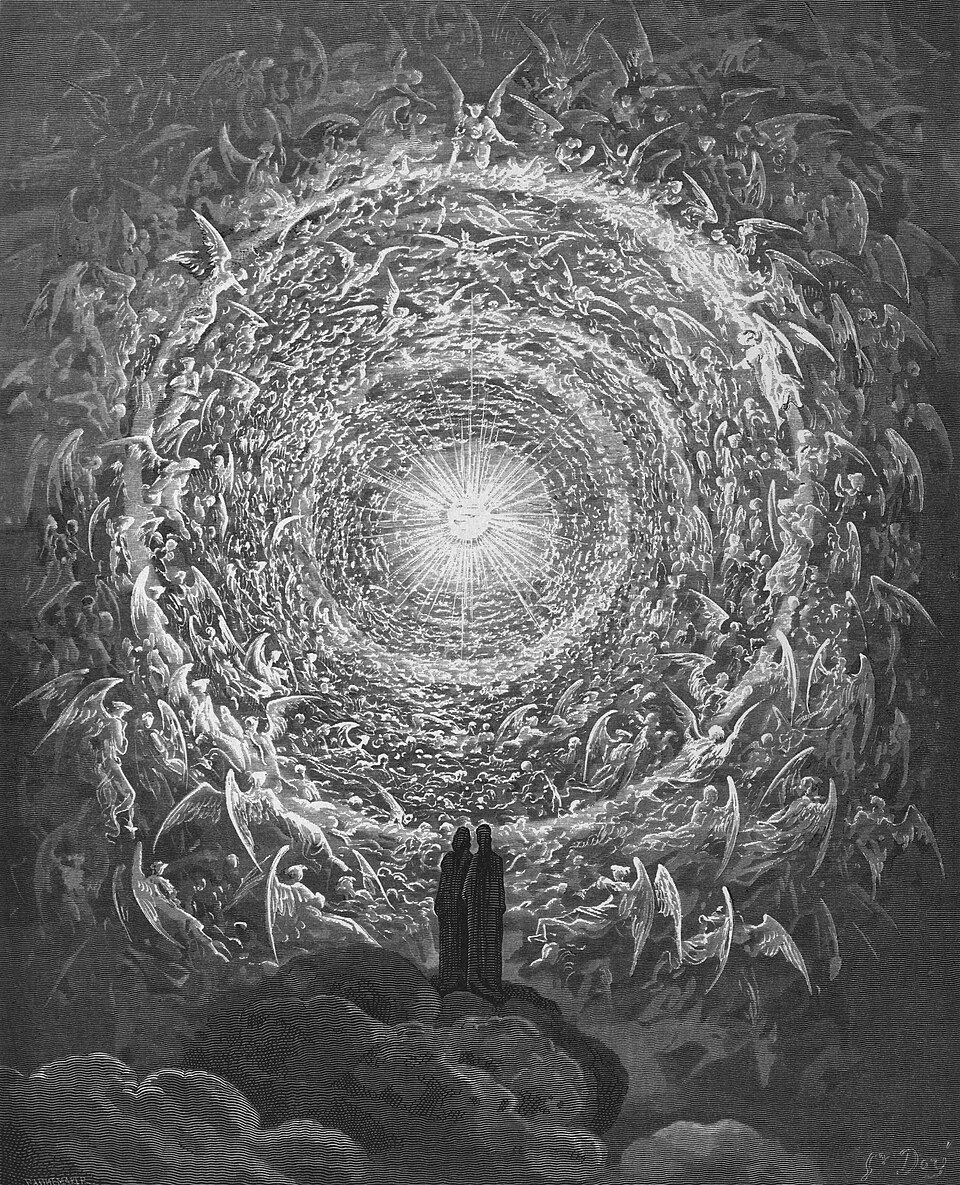
Dante’s vision of the numinosum
Dante’s is a visual imagination. It is a visual imagination in a different sense from that of a modern painter of still life: it is visual in the sense that he lived in an age in which men still saw visions. It was a psychological habit, the trick of which we have forgotten, but as good as any of our own. We have nothing but dreams; and we have forgotten that seeing visions – a practice now relegated to the aberrant and uneducated – was once a more significant, interesting, and disciplined kind of dreaming.
T.S. Eliot. The Varieties of Metaphysical Poetry
Psychedelic drugs short cut the long term disciplined practice needed for mystical experience. There is currently a renaissance of interest in the use of these drugs to boost the effectiveness of psychotherapy. A widely accepted principle of this psychedelic-assisted therapy, one supported by many empirical studies, is that the quality of peak mystical-like experiences occurring during the therapy sessions contributes significantly to a positive long-term outcome. When occurring spontaneously during drug-free depth psychotherapy, the bright light experience has similarly been found to be highly therapeutic7 with lasting beneficial effects. The peak experiences of bright light induced by ganzflicker visual stimulation, initially if needed in combination with a mini-dose of a psychedelic drug, may have a significant role to play in the psychiatry and neuroscientific illuminism of the future.
Please consider participating in our ganzflicker research project
The Induction of Mystical Experience by Ganzflicker Meditation

For further information:
Dr Pete Carr
September 2026
- Fingelkurts, A. A., Fingelkurts, A. A., & Kallio-Tamminen, T., 2016. Trait lasting alteration of the brain default mode network in experienced meditators and the experiential selfhood. Self and Identity, 15(4), 381-393. https://doi.org/10.1080/15298868.2015.1136351
- Lindahl, J.R., Kaplan, C.T., Winget, E.M. & Britton, W.B., 2014. A phenomenology of meditation-induced light experiences: traditional Buddhist and neurobiological perspectives. Frontiers in psychology, 4, p.66787. https://doi.org/10.3389/fpsyg.2013.00973
- Carr, P. 2025. On the Brightening of Subjective Luminosity in Ganzflicker Meditation: A Dual Pathway Hypothesis.
- Lehtonen, J.B. and Lehtinen, I., 1972. Alpha rhythm and uniform visual field in man. Electroencephalography and clinical neurophysiology, 32(2), pp.139-147. https://doi.org/10.1016/0013-4694(72)90136-8
- Toscani, M., Marzi, T., Righi, S., Viggiano, M. P., & Baldassi, S. 2010. Alpha waves: a neural signature of visual suppression. Experimental brain research, 207(3), 213-219. https://doi.org/10.1007/s00221-010-2444-7
- Chen, C.Y. & Hafed, Z.M., 2018. Orientation and contrast tuning properties and temporal flicker fusion characteristics of primate superior colliculus neurons. Frontiers in Neural Circuits, 12, 58. https://doi.org/10.3389/fncir.2018.00058
- Luthe, W., 1973. Unusual brightness and related phenomena. In: Autogenic Therapy, Volume VI: Treatment with Autogenic Neutralization. Grune & Stratton, New York, pp. 118–129. (Typographic re-setting; original pagination retained.)


© Copyright REM Autogenics – All rights reserved

